




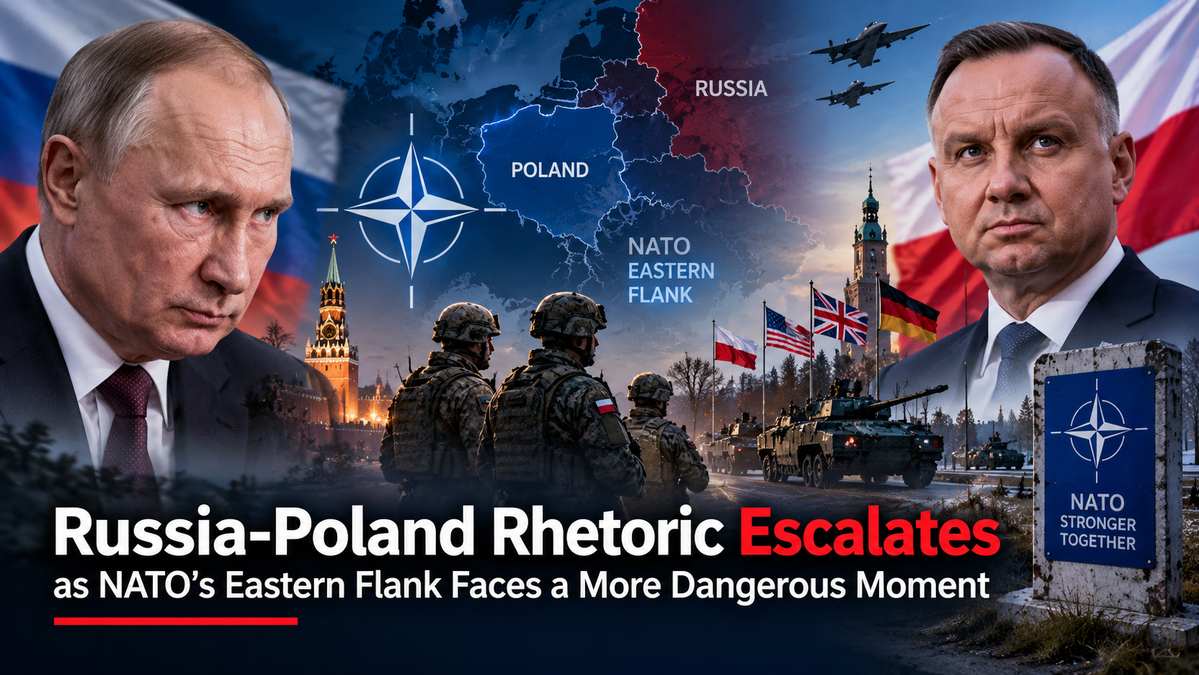
A sharp exchange between Moscow and Warsaw has pushed tensions on NATO’s eastern flank back into the spotlight.
Russian presidential aide Nikolai Patrushev has warned that Polish statehood could cease to exist within two or three days if Poland entered a military conflict with Russia.
His remarks came after Polish Foreign Minister Radosław Sikorski said NATO could defeat Russia relatively quickly if Moscow attacked the alliance.
The exchange is striking, but the words need to be placed in their proper context.
Sikorski was discussing a potential NATO-Russia conflict, while Patrushev responded specifically to the possibility of Poland itself entering hostilities with Russia. Neither statement represents a formal NATO declaration of war or an announcement by the Polish government that it intends to fight Russia.
The bigger concern is what these increasingly direct statements reveal about the security environment surrounding Poland.
A War of Words With a Real Security Backdrop
The latest rhetoric would be easier to dismiss as political messaging if tensions between Russia and NATO countries were not already elevated.
Poland has recently strengthened security along its border with Ukraine following Russian drone attacks in the region.
Polish authorities have reinforced border crossings with physical protective infrastructure, including barriers and observation posts, after incidents involving drones and nearby infrastructure.
That means the latest verbal confrontation is occurring alongside genuine military and security concerns.
For Warsaw, the issue is not simply what Russian officials say.
It is also what happens when drones, missiles or other military activity approaches NATO territory.
What Did Sikorski Actually Say?
Polish Foreign Minister and Deputy Prime Minister Radosław Sikorski made his comments at the Yalta European Strategy conference in Kyiv.
He argued that if Russia attacked Poland and Poland and its allies responded fully, NATO would have substantial military advantages.
Sikorski specifically pointed to NATO’s air-power advantage and said the alliance could defeat Russia “quite quickly.”
That wording generated attention because it was unusually direct.
But the distinction between Poland acting alone and NATO responding collectively is essential.
Poland is a NATO member.
An armed attack on Poland could potentially trigger consultations and collective-defense mechanisms under Article 5, although the treaty does not prescribe one automatic military response for every possible incident.
Sikorski’s comments were therefore about the broader alliance rather than a claim that the Polish armed forces alone could defeat Russia.
Patrushev’s Response Was Much More Severe
Nikolai Patrushev responded in an interview with the Russian newspaper Argumenty i Fakty.
He said that if Poland entered military action against Russia, Moscow would use its “entire arsenal” of available forces and means and that Polish statehood would cease to exist within two or three days.
The statement is a threat, but it is important not to add details that Patrushev himself did not provide.
He did not explicitly say in the quoted remarks that Russia would use nuclear weapons.
Russia possesses a large nuclear arsenal, but the statement itself did not specify what weapons would be used.
That distinction matters because headlines can easily turn a broad military threat into a more specific claim that the available evidence does not support.
Why Warsaw Is Speaking More Forcefully
Poland’s increasingly assertive security language comes amid a series of incidents involving Russian military activity near NATO territory.
Polish officials have recently warned of growing risks along the country’s eastern border.
Prime Minister Donald Tusk has said Poland expects Russia could target border crossings with Ukraine as part of efforts to disrupt Ukrainian trade and logistics.
Poland has also reinforced infrastructure around important crossings.
These measures suggest that Warsaw’s concern is not limited to the possibility of a conventional invasion.
It includes drones, sabotage, infrastructure disruption and other forms of pressure that can remain below the threshold of open war.
NATO’s Eastern Flank Has Become More Active
Poland is not the only NATO country dealing with unusual incidents.
In recent days, NATO aircraft have been involved in responding to drone activity over Lithuania.
A NATO fighter intercepted and destroyed a drone over Lithuanian territory after it entered the country’s airspace. Lithuanian authorities suspected it had come from Belarus.
Separately, Denmark reported that a Russian warship fired emergency flares near a Danish military helicopter operating over international waters.
The Danish government protested the incident, describing the action as dangerous.
These events do not amount to a NATO-Russia war.
But they illustrate how the boundary between the battlefield in Ukraine and the security environment of neighboring NATO states has become increasingly difficult to separate.
The Poland-Ukraine Border Is Particularly Sensitive
Poland has become one of Ukraine’s most important logistical and political partners since Russia’s full-scale invasion.
That makes Polish territory and infrastructure strategically significant.
Weapons, humanitarian supplies, officials and other traffic move through Poland toward Ukraine.
Russia has repeatedly targeted Ukrainian infrastructure close to Poland’s border.
Recent incidents have raised concerns in Warsaw about whether military operations could increasingly affect Polish territory or infrastructure.
For Poland, that creates a difficult security calculation.
It must support Ukraine while ensuring that Russian attacks do not spill across the border.
The Real Power of Article 5 Is Uncertainty
One reason rhetoric surrounding Poland matters so much is NATO’s collective-defense commitment.
Article 5 states that an armed attack against one member is considered an attack against all, although each ally determines what action it considers necessary.
That does not mean every border incident automatically produces a declaration of war.
NATO’s response to previous airspace incidents has involved consultations, air-defense deployments, increased surveillance and other defensive measures.
In September 2025, for example, NATO said numerous Russian drones had violated Polish airspace and that Polish, Dutch, Italian and German assets had participated in the defensive response. The North Atlantic Council subsequently discussed Poland’s request for Article 4 consultations.
That episode demonstrated the importance of carefully distinguishing between an airspace violation, a deliberate attack and a broader military conflict.
The Danger of Miscalculation
The greatest risk in an environment like this may not be that either side openly wants a major war.
It may be that repeated incidents gradually reduce the space for mistakes.
Imagine a drone crossing a border.
Was it deliberate?
Was it malfunctioning?
Was it launched by Russia, Belarus or another actor?
Was an attack intended for a military target but went off course?
How should NATO respond?
Each question can produce a different decision.
The more frequently such incidents occur, the greater the pressure on governments to respond quickly.
And speed can make careful escalation management harder.
Moscow and Warsaw Are Speaking to Different Audiences
The language from both sides also has a domestic and international audience.
Sikorski’s remarks can be understood partly as a deterrence message: Poland and its allies should not be viewed as weak or unprepared.
Patrushev’s response serves a different purpose: warning Poland and other NATO states about the potential costs of direct military involvement.
Neither statement by itself establishes what would actually happen in a war.
Military outcomes depend on forces, geography, logistics, intelligence, political decisions, alliance coordination and many other factors.
That is why predictions about how quickly one side would defeat the other should be treated as political statements rather than established military facts.
Russia’s War in Ukraine Shapes the Entire Calculation
The continuing war in Ukraine is the central background to the confrontation.
Russia remains heavily engaged in Ukraine, while NATO countries continue to support Kyiv in different ways.
Poland is particularly exposed because of its geography.
It borders Ukraine and Belarus and sits on NATO’s eastern flank.
That makes Poland simultaneously a major logistical corridor, a NATO frontline state and a country directly affected by military developments in neighboring Ukraine.
The security consequences therefore extend well beyond the battlefield itself.
Poland Is Reinforcing Its Defenses
Warsaw’s response has included practical defensive measures rather than only strong statements.
Poland has been reinforcing border crossings and building protective infrastructure designed to shield personnel and facilities from potential attacks.
These preparations reflect a broader European trend.
NATO’s eastern members are investing more heavily in air defense, surveillance, border protection and military infrastructure as the war continues.
The objective is not necessarily to prepare for an inevitable war with Russia.
It is to reduce vulnerability if an incident occurs.
The Military Balance Is More Complicated Than a Headline
The phrase “NATO can defeat Russia quickly” makes for a dramatic headline, but actual military comparisons are far more complicated.
NATO has a large combined military and industrial base.
Russia has substantial conventional forces, missile capabilities, nuclear weapons and significant wartime production capacity.
Geography also matters.
A theoretical conflict involving NATO and Russia would not resemble the current war in Ukraine exactly.
Nor would it necessarily unfold according to a simple comparison of aircraft numbers.
Air power would be important, but so would air defense, long-range missiles, electronic warfare, logistics, naval forces, cyber capabilities and nuclear deterrence.
For that reason, Sikorski’s statement should be understood as his assessment and deterrence message, not as an independently established prediction of the outcome of a future war.
Nuclear Weapons Make the Rhetoric More Serious
The possibility of nuclear escalation is one reason statements involving the destruction of a NATO member deserve careful attention.
Russia has one of the world’s largest nuclear arsenals.
NATO also includes the United States, Britain and France, all nuclear-armed states.
This makes any direct NATO-Russia conflict fundamentally different from a conventional confrontation between two neighboring countries.
Even if both sides publicly emphasize conventional capabilities, the existence of nuclear weapons creates an additional layer of deterrence and risk.
That is also why threatening the destruction of a NATO member carries implications well beyond Poland.
Poland’s Security Is Now a European Issue
Poland’s position has changed significantly since the beginning of Russia’s full-scale invasion of Ukraine.
Warsaw has expanded military spending and strengthened its armed forces.
It has also become increasingly central to NATO’s eastern defense planning.
The country’s geographic position makes it an important link between Western Europe and the Baltic and eastern NATO members.
Consequently, an attack on Poland would not be a localized event.
It would immediately raise questions about the alliance’s collective-defense commitments.
The Bigger Story Is the Shrinking Distance Between Words and Incidents
The most important part of the latest confrontation may therefore not be the dramatic language itself.
It is the environment in which that language is being exchanged.
Russian drones and military activity are generating increasing concern among NATO members.
Poland is strengthening border defenses.
NATO aircraft are responding to incidents in allied airspace.
European governments are discussing how to reinforce the alliance’s eastern flank.
Against that backdrop, statements from senior officials in Moscow and Warsaw carry greater weight than similar rhetoric might have carried several years ago.
What Happens Next?
The immediate question is whether the exchange remains rhetorical or is followed by further incidents.
Poland is likely to continue strengthening its border and air-defense posture.
NATO is likely to maintain surveillance and defensive deployments along its eastern flank.
Russia, meanwhile, has continued to reject Western descriptions of its actions as part of a deliberate campaign against NATO and has repeatedly criticized the alliance’s support for Ukraine.
The danger is that a series of individual incidents could gradually create a larger confrontation even without either side formally deciding to start one.
That makes communication, accurate attribution and proportional responses particularly important.
A Warning, Not a War Declaration
Patrushev’s statement is undoubtedly severe.
But it should not be confused with a Russian announcement that Moscow intends to attack Poland.
Likewise, Sikorski’s remarks should not be read as evidence that Poland is preparing to launch a war against Russia.
Both statements were framed around hypothetical conflict.
The more consequential reality is that Poland, Russia and NATO are operating in an increasingly tense security environment where hypothetical scenarios can become more difficult to keep hypothetical.
For Warsaw, the priority is strengthening deterrence and protecting its territory.
For Moscow, the priority remains preventing deeper NATO involvement while pursuing its war aims in Ukraine.
For NATO, the challenge is deterring further escalation without allowing individual incidents to spiral into a direct confrontation with Russia.
That is the real significance of this latest exchange.
The most dangerous part is not simply that Moscow and Warsaw are trading threats. It is that those threats are being made while military incidents are already occurring around NATO’s eastern borders.
In such an environment, every drone, border violation and public warning carries the potential to become more than a headline.