


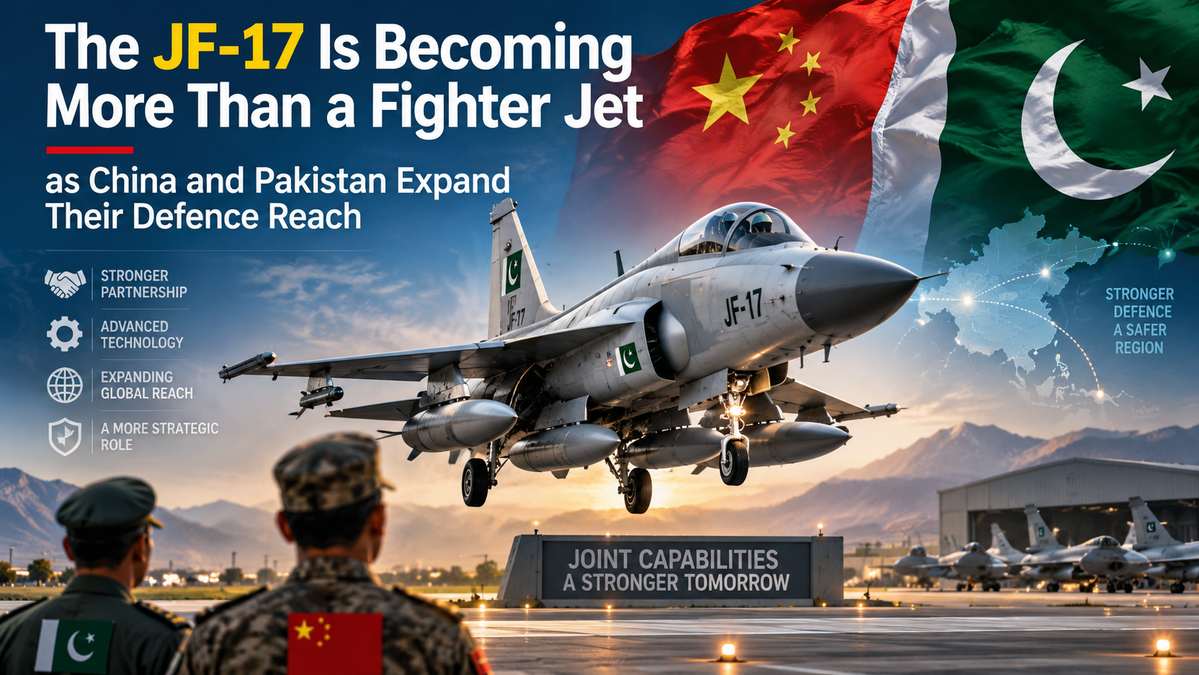
The JF-17 Thunder was originally conceived as a relatively affordable fighter aircraft.
Today, it is becoming something much bigger.
Jointly developed by Pakistan Aeronautical Complex and China’s Chengdu Aircraft Corporation, the JF-17 has emerged as one of the most visible symbols of the China-Pakistan defence relationship. Pakistan operates the aircraft, China provides critical technology and components, and both countries have an interest in finding new customers.
Recent reports of potential or reported JF-17 sales and negotiations with countries including Libya, Bangladesh, Saudi Arabia, Sudan, Indonesia and Somalia have drawn attention to the aircraft’s expanding international profile. However, these cases do not all represent completed contracts, and some remain at the stage of reported interest or negotiations.
That distinction matters.
But even before every reported deal becomes reality, the JF-17 is revealing something important about the changing global arms market.
Weapons are increasingly becoming instruments of industrial, diplomatic and strategic influence at the same time.
From Pakistan’s Fighter to an International Product
The JF-17 began life as a way for Pakistan to obtain a modern multirole fighter at a lower cost than many Western alternatives.
The aircraft first flew as a prototype in 2003 and subsequently entered Pakistan Air Force service.
Its development gave Pakistan an opportunity to expand its domestic aerospace manufacturing capabilities while maintaining a close relationship with China’s defence industry.
China, meanwhile, gained a partner through which its technology could reach international customers.
The arrangement is therefore unusual.
Pakistan is not simply buying a Chinese aircraft.
It is also involved in producing and marketing a platform that depends heavily on Chinese technology and supply chains.
That makes every successful export potentially valuable to both countries.
Why the JF-17 Is Attracting Attention
Price is an important part of the equation.
Many countries want modern combat aircraft but cannot afford the most expensive Western fighters or do not want the political conditions that can accompany those purchases.
The JF-17 offers another option.
It is a modern multirole fighter with relatively lower acquisition and operating costs than some high-end Western platforms.
For countries seeking to upgrade their air forces without making the enormous financial commitment associated with top-tier fighters, that can be attractive.
The aircraft’s export prospects have also received a boost from Pakistan’s claims about its combat performance.
Pakistan deployed JF-17s during its 2025 conflict with India, although claims about the aircraft’s performance and the wider outcome of that confrontation remain contested.
The label “combat-tested” can be powerful in the international arms market.
But it should not automatically be treated as proof of superiority.
China Does Not Operate the JF-17—So Why Does Beijing Matter?
One of the more interesting aspects of the aircraft is that China itself does not operate the JF-17.
Pakistan does.
Yet China remains central because the aircraft was jointly developed and relies on Chinese technology and components.
ThePrint’s reporting has also highlighted Pakistan’s dependence on China for important systems including avionics, electronic warfare equipment and weapons, while the aircraft’s engines have historically been sourced from Russia.
That creates a three-country industrial chain.
Pakistan provides manufacturing and operational experience.
China provides major technological and industrial inputs.
Russia has supplied the aircraft’s engine family.
The JF-17 is therefore not simply a Chinese or Pakistani product.
It is the result of a broader defence supply network.
The Export Map Is the More Interesting Story
The aircraft’s international customer base tells us more about the changing arms market than the fighter’s specifications alone.
Myanmar, Nigeria and Azerbaijan operate JF-17s, while additional countries have been linked to potential purchases or negotiations.
The political systems and strategic priorities of these countries differ considerably.
That makes it too simplistic to describe them all as belonging to one ideological bloc.
Some seek affordable military equipment.
Some want to diversify their suppliers.
Some face security challenges.
Others may see defence cooperation as a way to deepen relationships with Pakistan or China.
The common factor is not necessarily ideology.
It is that the JF-17 provides an alternative route into modern combat aviation.
Libya Is a Particularly Sensitive Case
The reported JF-17 discussions involving Libya have attracted attention because the aircraft has reportedly been linked to the Libyan National Army led by Khalifa Haftar.
Libya remains divided between rival political and military centers, and the international legal environment surrounding arms transfers is highly sensitive.
The United Nations has maintained an arms embargo on Libya since 2011, subject to its applicable exemptions and procedures.
That makes any potential transfer more complicated than an ordinary commercial defence sale.
A reported deal should therefore not automatically be described as an accomplished transfer.
The important question is whether and how such a transaction could comply with applicable international restrictions.
Myanmar Shows the Complications of Defence Exports
Myanmar provides another important example.
The country became the first foreign operator of the JF-17.
It has also faced international sanctions and a prolonged civil conflict following the 2021 military takeover.
The aircraft’s operational history in Myanmar has been complicated, with reports over the years about technical problems and difficulties keeping parts of the fleet operational.
This illustrates an important reality of defence exports.
Selling a fighter is only the beginning.
Customers need spare parts, maintenance, pilot training, technical assistance and upgrades.
Those support networks can create relationships that last for decades.
And that is where the strategic value of arms exports can become much greater than the original sale price.
Arms Sales Create Long-Term Relationships
Consider what happens after a country purchases a fighter aircraft.
Pilots must be trained.
Ground crews must learn maintenance procedures.
Weapons need to be integrated.
Spare parts must be supplied.
Software and avionics may require updates.
Simulators and training infrastructure may be installed.
A country that buys a particular aircraft therefore develops an ecosystem around it.
That ecosystem can influence future procurement decisions.
If the relationship works well, the customer may return for additional aircraft, missiles, drones or other systems.
This is one reason defence exports can become instruments of long-term influence.
Pakistan Has an Economic Incentive
There is also a domestic economic dimension.
Pakistan has sought to expand defence exports as part of its broader effort to generate foreign currency and strengthen its industrial base.
The JF-17 offers Pakistan something it has historically lacked: a major military product that it can help manufacture and market internationally.
Pakistani officials have promoted defence exports as a potential source of significant revenue.
But reported negotiations should not be confused with money already received.
A proposed order is not the same thing as a signed contract, and a signed contract is not the same thing as completed deliveries.
That distinction is particularly important given the number of JF-17 deals reported or discussed during the past year.
China’s Benefit Goes Beyond Aircraft Sales
For Beijing, the potential advantage is broader.
China can benefit when its technology becomes embedded in another country’s armed forces.
A customer that operates Chinese-linked aircraft may subsequently require Chinese weapons, sensors, communications equipment, maintenance support or other systems.
That can create an expanding defence ecosystem.
This does not mean every JF-17 customer becomes politically aligned with China.
Countries routinely buy weapons from multiple suppliers.
But defence equipment can create institutional relationships that are difficult to replace quickly.
The “Authoritarianism Export” Argument Needs Nuance
The original opinion article argues that the JF-17’s export pattern demonstrates an emerging relationship between arms sales and the spread of authoritarian influence.
That is an important argument to examine.
But it should remain clearly identified as an interpretation.
The fact that a fighter is sold to a country with weak democratic institutions does not by itself prove that the seller is exporting an ideology.
There are several possible explanations for a purchase.
Cost.
Availability.
Political relationships.
Weapons compatibility.
Training requirements.
Sanctions.
The absence of attractive alternatives.
Strategic calculations.
All can influence procurement decisions.
The evidence therefore supports a discussion about defence influence, but the broader claim about exporting authoritarianism requires a stronger causal demonstration.
Defence Cooperation Can Still Have Political Consequences
That caveat does not make the strategic issue irrelevant.
Weapons partnerships can influence foreign policy.
If two countries conduct joint exercises, exchange military personnel and develop weapons together, their armed forces become more familiar with each other’s systems.
Shared training can also create institutional relationships.
Over time, those links can make broader political cooperation easier.
This is particularly important when defence partnerships develop alongside infrastructure, investment and trade.
Military cooperation then becomes one part of a much larger relationship.
Pakistan Is Building a Wider Defence Network
The JF-17 is not operating in isolation from Pakistan’s other defence relationships.
Islamabad has also expanded cooperation with Türkiye and other partners.
Pakistan has sought to market drones, aircraft and other defence products internationally.
The country’s military leadership has played an important role in these efforts.
That means the JF-17 can be viewed as one component of a broader attempt to turn Pakistan from primarily a weapons importer into a more significant defence exporter.
Whether that transformation succeeds will depend on production capacity, financing, reliability and international demand.
Türkiye Shows How Combat Experience Can Become a Sales Tool
Türkiye’s Bayraktar drones provide a useful comparison.
Turkish defence companies have successfully used the battlefield performance and international visibility of their unmanned systems to expand exports.
The JF-17’s proponents are pursuing a similar logic.
If the aircraft demonstrates useful capabilities in actual combat, that experience can become part of its marketing story.
But combat experience also cuts both ways.
Potential customers will examine not only whether an aircraft was used successfully, but also losses, technical performance, maintenance requirements and the quality of the weapons and sensors integrated with it.
The Arms Market Is Becoming More Competitive
The global weapons market is no longer dominated by a small group of Western suppliers.
China, Türkiye, South Korea, Israel, India, Russia and others are competing for customers across Asia, Africa and the Middle East.
Countries have more choices.
Some want Western equipment.
Others prefer Chinese or Turkish systems.
Some deliberately diversify among several suppliers to avoid becoming dependent on one country.
The JF-17’s prospects need to be understood within this larger competition.
Its biggest advantage may not be ideology.
It may simply be that it gives another group of countries a fighter option that sits between older aircraft and much more expensive fifth-generation platforms.
Africa Could Become an Important Market
Africa is particularly significant because many countries face security challenges while operating under severe budget constraints.
Several governments need combat aircraft, drones, surveillance systems and air-defense equipment.
But they may not have the resources to purchase the most expensive systems on the market.
That creates an opening for lower-cost platforms.
Pakistan and China are not the only countries seeking this market.
Türkiye has expanded its defence exports across Africa as well.
Competition is therefore likely to intensify.
There Is Another Side to the Export Story
Defence exports can bring jobs, technology and foreign exchange.
They can help countries build domestic manufacturing capabilities.
They can also give smaller states access to equipment that would otherwise be financially out of reach.
But arms transfers can have serious consequences when weapons are supplied to governments or armed groups involved in internal conflicts.
That is why export controls, end-user monitoring and international law matter.
A fighter aircraft is not simply another manufactured product.
Once delivered, it becomes part of a country’s military capabilities.
The JF-17 Is Also a Lesson in Supply-Chain Power
Perhaps the most overlooked aspect of the aircraft is what it says about modern military production.
No country necessarily needs to build every component itself.
Pakistan can manufacture the aircraft with Chinese assistance.
China can provide avionics and weapons.
Russia has supplied engines.
Other partners can provide additional systems.
This creates a distributed industrial model.
But it also creates vulnerabilities.
If one supplier faces sanctions, production delays or political restrictions, the entire program can be affected.
The JF-17’s future therefore depends not only on Pakistan and China but on the resilience of the broader supply chain.
The Real Competition May Be Over Defence Ecosystems
The future of the JF-17 may ultimately be determined less by the number of aircraft sold than by the ecosystem built around them.
If Pakistan and China can provide affordable aircraft, reliable maintenance, weapons, training and upgrades, customers may remain tied to the platform for decades.
That is much more strategically significant than a one-time sale.
It creates relationships between air forces, defence ministries and industrial companies.
And it gives suppliers an enduring presence in another country’s security architecture.
But Reported Orders Still Need to Become Real Deliveries
There is one important reason to remain cautious about the JF-17’s apparent export boom.
Reports of negotiations and expressions of interest can generate enormous publicity.
But defence contracts often take years to finalize.
Financing can change.
Political governments can change.
Military requirements can change.
Sanctions can intervene.
Delivery schedules can slip.
ThePrint itself previously examined the gap between Pakistan’s reported JF-17 orders and the country’s actual production capacity, noting its continued dependence on China for key systems.
So the headline number of interested countries should not be treated as equivalent to confirmed aircraft deliveries.
The Bigger Story: Influence Through Infrastructure
The JF-17’s international expansion nevertheless reveals a broader change in the global defence market.
Influence is no longer built only through military bases or formal alliances.
It can also emerge through aircraft, drones, missiles, training programs, maintenance contracts and supply chains.
Once a country’s military becomes accustomed to another country’s equipment, a long-term relationship can develop around it.
That is why defence exports deserve to be viewed as both commercial transactions and instruments of international engagement.
What the JF-17 Means for China and Pakistan
For Pakistan, the fighter represents an opportunity to turn defence manufacturing into a larger export industry.
For China, it offers another route for Chinese technology to become embedded in foreign military systems.
For customers, it provides an alternative to more expensive Western aircraft and may offer access to a wider defence relationship.
But none of those outcomes automatically produces a political alliance.
Each customer will make its own calculations.
The New Battlefield Is Also the Arms Market
The JF-17 story ultimately points to a competition that extends far beyond aircraft performance.
China is expanding its defence-industrial reach.
Pakistan is trying to monetize its military-industrial capabilities.
Türkiye is growing its own export footprint.
Western countries continue to dominate important segments of the global arms market.
And developing countries are increasingly shopping around for equipment that fits their budgets and strategic requirements.
That makes the JF-17 more than a fighter jet.
It is a test of whether a relatively affordable, jointly produced military platform can create a durable network of industrial and strategic relationships across regions where major powers are competing for influence.
The argument that such exports amount to “exporting authoritarianism” remains a political interpretation rather than an established fact.
But there is a more concrete question worth watching: when a country buys the aircraft, how much of the supplier’s technology, training, maintenance and defence ecosystem does it eventually buy with it?
That may be where the JF-17’s real geopolitical significance lies.
The fighter’s biggest legacy may not be the number of aircraft eventually sold.
It may be the network of relationships built around every aircraft that leaves the factory.