


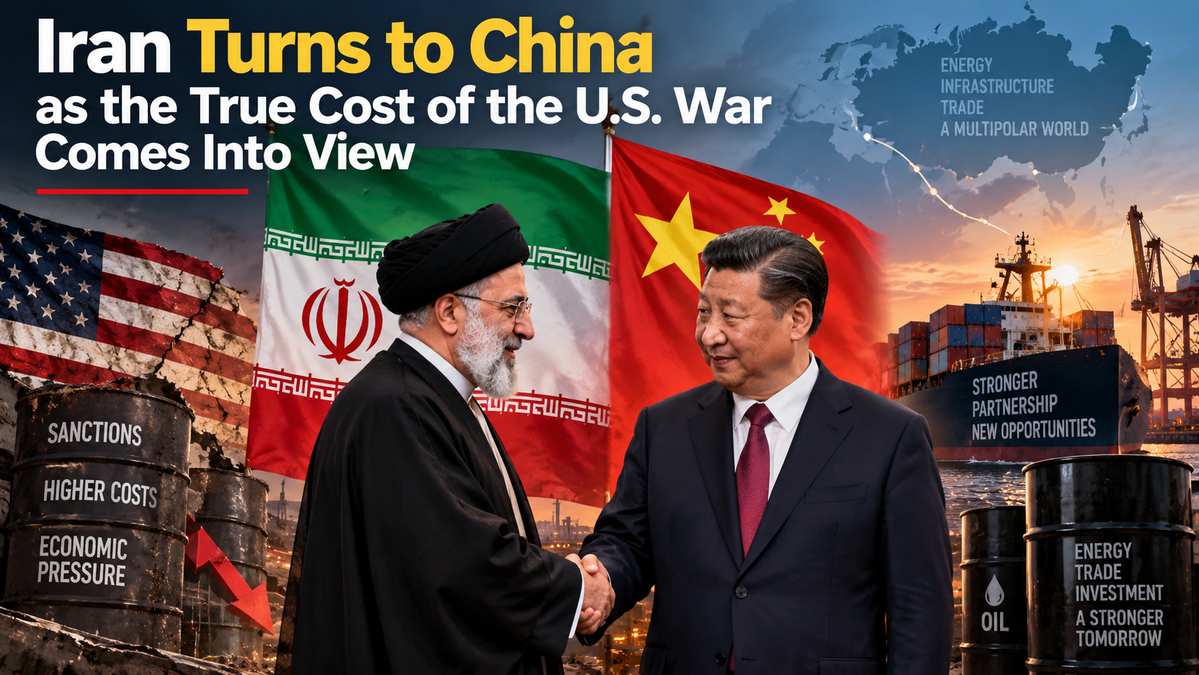
As the war between the United States and Iran enters another difficult phase, two very different stories are unfolding at the same time.
Iran’s Foreign Minister Abbas Araghchi is heading to China for talks with Chinese Foreign Minister Wang Yi, while new U.S. government assessments are revealing just how expensive the conflict has become for Washington.
The timing is striking.
On one side, Tehran is looking toward Beijing for diplomacy and regional support. On the other, the United States is confronting billions of dollars in military spending, depleted weapons stocks, damaged equipment and continuing pressure on global energy markets.
The Congressional Budget Office estimates that the U.S. war with Iran had already cost the Department of Defense about $38 billion by August 1, with the monthly cost potentially rising by another $2 billion to $3 billion if fighting continues at a similar intensity.
That makes the latest diplomatic movement more than another foreign-minister visit.
It comes as the economic and military consequences of the war are becoming increasingly difficult to ignore.
Iran’s Foreign Minister Heads to Beijing
Iranian Foreign Minister Abbas Araghchi is scheduled to travel to China for discussions with Wang Yi as Tehran seeks diplomatic engagement while the conflict continues.
The meeting puts China in an important position.
Beijing has maintained relations with Tehran and has consistently presented itself as a supporter of diplomacy and regional stability.
For Iran, China is also a major economic partner.
The talks therefore provide Tehran with an opportunity to discuss not only the immediate war but also the wider consequences for energy, shipping, sanctions and regional security.
Why China Matters to Iran
China’s importance goes beyond diplomacy.
It is Iran’s largest trading partner and a major buyer of Iranian oil.
Beijing also has relationships with other major players in the Middle East, giving it channels that Washington does not necessarily possess.
That makes China a potentially useful diplomatic destination for Tehran at a moment when the conflict has disrupted trade routes and created uncertainty around the Strait of Hormuz.
But a meeting between Iranian and Chinese officials should not automatically be interpreted as evidence that Beijing has agreed to intervene militarily or take Iran’s side in the conflict.
Diplomatic engagement and military alignment are very different things.
Meanwhile, Washington Is Counting the Cost
The financial numbers emerging in Washington are significant.
The CBO estimates that the conflict had cost the U.S. military approximately $38 billion through August 1.
The estimate includes the replacement of expended munitions, equipment losses, fuel and other operational expenses.
The Pentagon’s inspector general had previously estimated the cost at $33.4 billion through June 29.
The two numbers are not contradictory. They cover different periods.
The later CBO estimate captures additional weeks of military operations and therefore produces a higher total.
And the bill is still growing.
The Monthly Price of Continuing the War
The CBO estimates that the conflict could add roughly $2 billion to $3 billion per month, depending on the intensity of fighting.
That creates a very different calculation from the headline cost of the war.
A conflict that costs $38 billion is already expensive.
A conflict that continues adding several billion dollars every month becomes a long-term budget problem.
The calculation becomes even more complicated because these figures do not capture every possible future expense, including some reconstruction and longer-term human costs.
Munitions Are One of the Biggest Expenses
Weapons have been among the most expensive components of the campaign.
The Pentagon inspector general estimated that approximately $22.3 billion of the $33.4 billion cost through June 30 was associated with munitions.
The CBO separately estimated that replacing munitions used through August 1 would cost about $21.7 billion.
The exact totals differ because the reports use different dates and methodologies, but they point toward the same conclusion:
A high-intensity modern air war consumes enormous quantities of expensive weapons.
That is particularly important for systems that cannot simply be produced overnight.
The Hidden Problem: Rebuilding the Arsenal
The financial cost is only part of the story.
The United States can spend money to replace weapons, but manufacturing them requires time, factories, raw materials and skilled workers.
The CBO warned that U.S. stocks of some missile-defense interceptors have fallen substantially.
Its analysis suggested that the United States may have used between half and two-thirds of its inventory of certain missile-defense weapons since June 2025. It estimated that rebuilding those stocks could take years.
That creates what economists and military planners sometimes call an opportunity cost.
A missile fired today is not available tomorrow.
A factory producing replacements for one conflict may not be able to produce the same equipment for another contingency.
Why China Is Part of the Calculation
This is where the financial story becomes a strategic one.
U.S. officials and defense analysts have long considered China the country’s most significant potential military competitor.
The CBO specifically warned that depleted missile-defense inventories could become a problem in a potential conflict involving China, which possesses a large ballistic- and cruise-missile arsenal.
That does not mean the United States is currently preparing for a war with China.
It means that the Iran conflict is forcing U.S. planners to think about how quickly their military stocks can be restored while another major strategic challenge remains.
The issue is therefore not simply how much the war costs.
It is what the United States has less of because of the war.
The Pentagon Disputes the Picture of a Crisis
The emerging reports have also produced disagreement inside Washington.
Pentagon officials have pushed back against descriptions suggesting that the U.S. military lacks enough weapons to continue its operations.
Defense Secretary Pete Hegseth has previously said the United States has sufficient ammunition for its current needs.
The Pentagon’s position does not necessarily contradict the CBO’s warning.
A military can have enough weapons to continue a current operation while simultaneously having insufficient stocks for an unexpected major conflict elsewhere.
That distinction is important.
The War Is Also Damaging U.S. Military Equipment
The inspector general’s report documented substantial equipment losses and damage.
It included four F-15 aircraft destroyed, an F-35 damaged, several KC-135 tanker aircraft damaged and up to 30 MQ-9 Reaper drones destroyed.
The report also documented extensive damage to U.S. facilities across the Middle East.
Hundreds of buildings and structures at American military bases were damaged or destroyed by Iranian attacks, according to the watchdog report.
The cost of repairing that infrastructure is not fully reflected in the headline figures.
Iran Has Targeted the U.S. Regional Network
The damage is significant because the United States relies on a network of bases across the Middle East to support operations.
Facilities in countries including Bahrain, Kuwait, Qatar, Saudi Arabia, the United Arab Emirates, Iraq, Oman and Jordan have been affected.
The Pentagon inspector general also reported approximately $184 million in damage to U.S. diplomatic facilities caused by Iranian strikes.
The conflict has therefore become much larger than an exchange of aircraft and missiles over Iran.
It has become a regional military operation involving bases, logistics networks, diplomatic facilities and shipping routes.
The Strait of Hormuz Is the Economic Pressure Point
Perhaps nowhere is the wider economic impact more visible than the Strait of Hormuz.
The waterway is one of the world’s most important routes for oil and gas shipments.
Disruptions there have contributed to higher energy prices and increased uncertainty in global markets.
The CBO estimated that the conflict could raise U.S. inflation by about 0.5 percentage points in the first quarter of 2027 compared with its earlier projection.
That means the war is no longer simply a defense-budget issue.
Its effects can reach consumers through fuel, transportation and other prices.
A War That Reaches the Household Budget
There is a simple chain connecting the battlefield to ordinary consumers.
Missiles disrupt shipping.
Shipping disruptions reduce the availability of energy supplies.
Energy prices rise.
Higher energy costs feed into transportation and production expenses.
Businesses pass some of those costs to consumers.
The result is inflationary pressure.
The CBO said energy disruptions linked to the war were already affecting its inflation outlook.
That makes the Strait of Hormuz strategically important far beyond the Middle East.
Iran Has an Economic Stake Too
Iran is also paying a heavy price for the conflict.
The country depends significantly on energy exports and maritime trade.
Any prolonged disruption to shipping can damage its own economy.
At the same time, Iran can use its geographic position and influence over regional waterways as leverage.
That creates a difficult balance.
Tehran has incentives to maintain pressure on the United States and its partners, but prolonged disruption can also impose costs on Iran itself.
Why Tehran Is Looking Toward Beijing Now
This helps explain the significance of Araghchi’s trip to China.
Diplomacy becomes more valuable when military pressure is producing economic costs.
Iran can use its relationship with Beijing to discuss sanctions, trade, energy markets and regional security.
China, meanwhile, has an interest in stable energy flows and functioning shipping routes.
Neither side needs to agree on every aspect of the war for those interests to overlap.
China Has Its Own Reason to Watch Hormuz
China is one of the world’s largest energy importers.
A prolonged disruption in the Persian Gulf therefore affects Chinese companies and consumers as well.
Beijing has an interest in preventing instability from becoming a permanent feature of global energy markets.
That gives China a reason to engage diplomatically even if it does not become a direct participant in the conflict.
The upcoming talks should therefore be viewed through both a diplomatic and an economic lens.
The War Is Creating a Strange Strategic Paradox
The United States possesses enormous military capabilities.
But modern warfare is not simply about having the most advanced aircraft or missiles.
It is also about how quickly those weapons can be replaced.
The Iran conflict demonstrates the difference between military power on paper and sustainable military power over time.
A country can launch thousands of expensive weapons in a short period.
The harder question is whether its industrial base can replace them quickly enough while maintaining readiness for another crisis.
The Industrial Base Has Become Part of the Battlefield
The Pentagon inspector general identified production bottlenecks affecting the U.S. ability to replenish munitions.
That shifts the discussion from battlefield tactics to manufacturing capacity.
How many missiles can factories produce each month?
How quickly can specialized components be manufactured?
How much skilled labor is available?
How much of the supply chain depends on a limited number of producers?
Those questions rarely dominate daily headlines.
But in a prolonged war, they can become decisive.
The Financial Clock Is Now Running Alongside the Military Clock
Washington therefore faces two clocks.
The first is military: how long can the United States sustain its current operational tempo?
The second is financial: how much additional money will Congress have to approve if the war continues?
The White House has sought additional funding for the Pentagon, while congressional lawmakers have increasingly scrutinized the cost of the conflict. The CBO’s latest estimate adds another layer to that debate.
Every additional month potentially increases both the weapons bill and the pressure on inventories.
What Iran’s China Visit Could Mean
The China visit does not guarantee a diplomatic breakthrough.
But it does show that Iran is looking beyond the battlefield.
Tehran needs relationships that can help it manage the economic and diplomatic consequences of the conflict.
Beijing has the economic weight and diplomatic relationships to matter.
The discussions could touch on regional security, energy, trade and the future of the conflict.
The precise outcome, however, remains uncertain.
The Bigger Story Is No Longer Just Who Is Winning
The war is increasingly raising a different question:
How sustainable is the conflict for everyone involved?
For Iran, the costs include damage, economic disruption and pressure on trade.
For the United States, the costs include tens of billions of dollars, depleted munitions stocks, damaged aircraft and infrastructure, and higher energy-related inflation.
For China and other major economies, disrupted energy routes create their own risks.
That means the conflict’s consequences are spreading far beyond the countries firing the weapons.
A Diplomatic Opening Meets a Financial Reckoning
Iran’s foreign minister heading to Beijing and Washington’s newly published war-cost estimates may appear to be unrelated stories.
They are not.
Both point toward the same underlying reality: the longer the conflict continues, the harder it becomes to separate military strategy from economics and diplomacy.
Iran is seeking diplomatic space.
The United States is facing a growing replacement bill.
China has an interest in regional stability and energy security.
And global markets are absorbing the consequences of disrupted shipping through one of the world’s most important waterways.
The CBO’s $38 billion figure is therefore more than a headline number. It represents weapons fired, equipment lost, fuel consumed and military operations sustained. It also points toward future costs, with another $2 billion to $3 billion potentially added every month if the conflict remains intense.
The Pentagon inspector general’s findings add another warning: rebuilding some depleted weapons stocks could take years.
What Happens Next?
The coming diplomatic moves will be closely watched.
Araghchi’s discussions in Beijing could provide clues about Iran’s diplomatic strategy.
Washington, meanwhile, faces the challenge of maintaining military operations while replenishing weapons and dealing with the economic consequences of the conflict.
And the Strait of Hormuz remains the critical link connecting the military crisis to the global economy.
The most important question may therefore no longer be simply how much longer the fighting can continue.
It is whether the economic, industrial and diplomatic pressures created by the war eventually become powerful enough to change the calculations of the governments involved.
For now, the contrast is striking:
Iran is sending its foreign minister to Beijing to pursue diplomacy, while Washington is discovering just how expensive the military path has become.
And as the bill grows, the war’s most consequential battlefield may increasingly be found not only in the skies over Iran or around the Strait of Hormuz, but inside government budgets, weapons factories and diplomatic rooms far beyond the Middle East.