



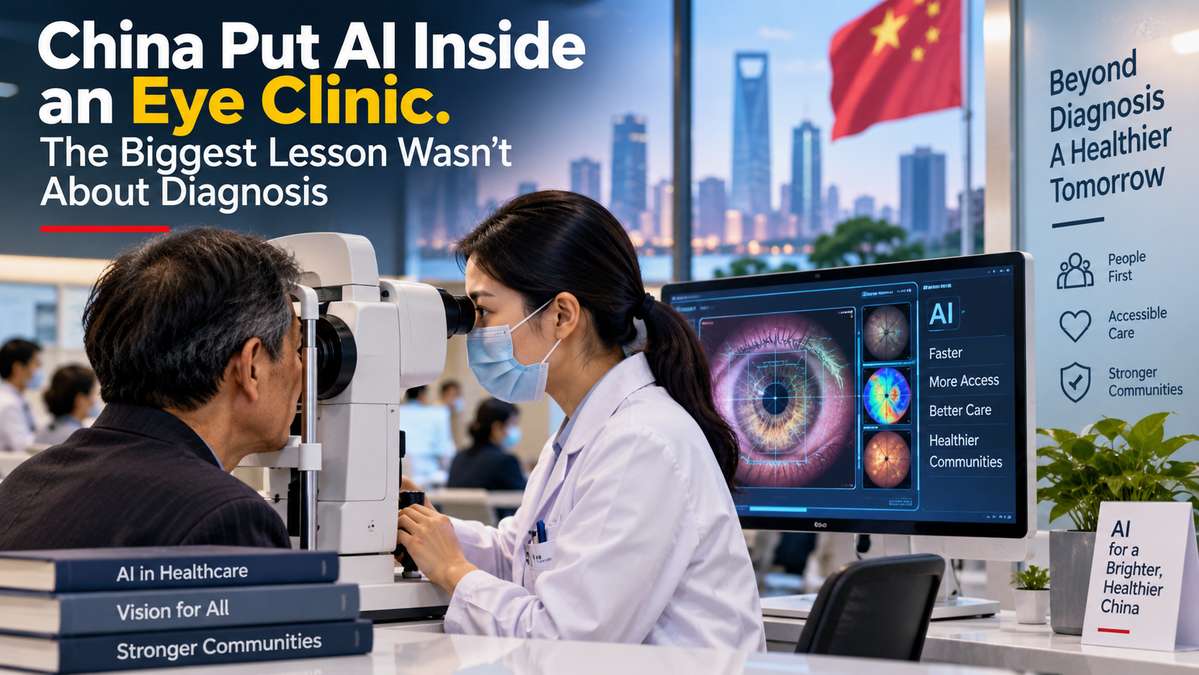
What happens when artificial intelligence is given a major role inside a real eye clinic?
China has offered an early answer—and it is more complicated than the idea of an “AI doctor” replacing humans.
Researchers in China tested an AI-focused eye clinic designed to use artificial intelligence across much of the patient journey, from pre-consultation and eye scans to follow-up care. Human doctors remained involved, but the experiment was designed to find out how far AI could actually fit into everyday clinical work.
The results offer a surprising lesson.
The hardest part was not necessarily teaching AI how to recognize disease. It was getting the technology to work smoothly enough that medical staff would actually use it.
That could be one of the most important lessons for the future of AI in healthcare.
China’s AI Eye Clinic Was a Real-World Test
The project, known as the AI-Agent Augmented Tsinghua Eye Clinic, or AI-TEC, was developed by researchers connected with the Beijing Visual Science and Translational Eye Research Institute.
Rather than simply placing an AI diagnostic tool beside a doctor, researchers attempted to integrate AI into multiple stages of the clinical process.
The system could assist with pre-consultation, patient information, eye imaging and follow-up.
That distinction matters.
A laboratory test can show that an algorithm recognizes patterns in medical images. A hospital is different. Patients arrive with incomplete information. Doctors work under time pressure. Staff have to navigate computer systems. Every extra click can slow the process down.
Healthcare is not a clean laboratory.
It is more like a busy airport: even if one machine works perfectly, the entire system can still fail if the surrounding process is too slow or complicated.
The AI Became Better With Better Data
One of the most striking findings involved the quality of the training data.
The researchers initially trained the system using nearly 27,000 eye images.
That sounds impressive.
But more data did not automatically mean better performance.
Researchers later supplied the AI with 1,426 high-quality eye-scan images carrying accurate diagnoses. After this additional training, the system’s performance improved significantly. It achieved an AUROC above 0.93 when identifying conditions including glaucoma and age-related macular degeneration.
The lesson is important beyond ophthalmology.
AI systems do not simply need enormous amounts of information.
They need reliable, accurately labeled and clinically useful information.
In other words, a smaller box of carefully sorted medical records can sometimes be more valuable than a warehouse full of messy data.
Accuracy Was Only Half the Experiment
If the story ended with an impressive diagnostic score, it would be relatively straightforward.
But it didn’t.
Researchers discovered that clinical adoption was a major challenge.
During the first five months, the AI system was used in only 41 of 1,113 examinations, equivalent to about 3.8 percent.
That number changed after the researchers redesigned the system.
They made it faster, reduced manual work and cut down the number of clicks required by medical staff.
After those changes, AI was used in 259 of 1,126 examinations, or about 23 percent.
The improvement tells us something that benchmark tests often miss.
Doctors may be willing to use an AI system if it genuinely saves time.
They are much less likely to embrace one that creates another layer of work.
The “Last Mile” Problem in Medical AI
Technology companies often talk about model accuracy.
Hospitals have another question:
Does this actually make my day easier?
That is the medical version of the “last mile” problem.
An AI model can perform extremely well in testing but still struggle to become part of ordinary clinical practice.
Imagine giving a doctor an assistant who can analyze thousands of scans but requires the doctor to manually enter information into five different systems every time.
Technically impressive?
Yes.
Convenient?
Not necessarily.
The Chinese eye-clinic experiment demonstrates that successful medical AI needs to fit the workflow rather than forcing doctors to redesign their entire working day around a machine.
Doctors Still Had Something AI Could Not See
There is another important limitation.
An AI system can examine an image and estimate whether a particular disease is present.
A doctor has to consider the person behind that image.
A patient’s symptoms, medical history, medications, age, lifestyle and other conditions can all influence a diagnosis.
A scan might suggest one possibility while the patient’s wider clinical picture points toward another.
That is why the researchers emphasized cooperation between AI and clinicians rather than treating the technology as an autonomous replacement for medical professionals.
This distinction is crucial.
The future described by the study is not necessarily “doctor versus machine.”
It is increasingly doctor plus machine.
AI Needs Doctors to Teach It
Another lesson from the experiment concerns feedback.
AI systems operating in healthcare cannot simply be installed and forgotten.
Doctors need to provide timely feedback when the system produces a useful recommendation, misses something important or generates an impractical suggestion.
Researchers noted that delayed feedback can make improvement more difficult because clinical environments move quickly.
This creates a continuous loop:
AI assists → doctors review → clinicians provide feedback → the system improves → AI assists again.
That cycle could become one of the defining features of AI-assisted medicine.
Tsinghua Is Building Something Bigger
The eye clinic is also part of a larger project at Tsinghua University.
The university’s AI hospital initiative has been designed around both virtual and real-world medical environments.
In its virtual environment, AI agents can simulate large numbers of patient interactions and medical scenarios.
In physical hospitals, AI assistants can help doctors with tasks such as medical documentation, information retrieval and clinical decision support.
Chinese reporting on the project says the system has expanded across numerous clinical departments and is being tested with real doctors and patients. It also emphasizes that final medical decisions remain with human doctors.
That model is considerably more ambitious than simply adding a chatbot to a hospital website.
Why Eye Care Is a Natural Testing Ground
Ophthalmology is particularly suitable for AI research because so much of diagnosis depends on medical imaging.
Retinal photographs and other eye scans contain visual patterns that algorithms can analyze.
Conditions such as glaucoma and age-related macular degeneration can therefore become useful targets for computer-assisted screening and diagnosis.
That does not mean every eye examination can be automated.
Instead, AI can potentially handle parts of the information-heavy process while doctors concentrate on interpretation, patient communication and decisions requiring broader clinical judgment.
The Biggest Challenge May Be Trust
There is another barrier that cannot be measured by AUROC.
Trust.
Would a patient accept an AI-generated recommendation?
Would a doctor rely on it when the case is unusual?
Who is responsible if an AI system misses a disease?
What happens when the AI disagrees with a specialist?
These questions become more important as systems move from experimental environments into actual healthcare.
A machine can produce an answer in milliseconds.
Medicine still needs someone accountable for what happens next.
More Data Doesn’t Automatically Mean Better Medicine
The Chinese study also challenges a common assumption about AI.
People often imagine that the path to better artificial intelligence is simply collecting more data.
Healthcare is different.
Bad labels can teach an AI system the wrong lesson.
Inconsistent scans can introduce noise.
Incomplete patient records can produce misleading patterns.
Poorly designed workflows can make even an accurate system practically useless.
The 1,426 carefully labeled images used in the Chinese experiment are a reminder that data quality can matter as much as data quantity.
AI’s Real Test Is What Happens Between Patients
Perhaps the most revealing number from the experiment isn’t the system’s diagnostic score.
It is the change from 3.8 percent usage to 23 percent after the researchers made the technology easier to operate.
That is where the real story lies.
AI does not practice medicine in a vacuum.
It has to survive the everyday realities of medicine: queues, paperwork, tired staff, complicated software, limited time and patients who do not behave like textbook examples.
An AI system that is technically brilliant but practically frustrating may never become widely useful.
This Is Not Yet an AI-Only Hospital
The headline “China let AI run an eye clinic” is attention-grabbing, but it needs context.
The experiment did not demonstrate that AI independently replaced ophthalmologists.
Human doctors remained involved in patient care, and the researchers highlighted the need for clinical oversight.
The more accurate description is that China tested a highly AI-integrated clinical workflow.
That may sound less dramatic.
It may also be more important.
Replacing doctors entirely is a much bigger—and more controversial—goal than giving doctors increasingly capable digital assistants.
What This Could Mean for Patients
If systems like this eventually mature, patients could benefit in several ways.
AI could help identify suspicious images earlier.
It could organize medical information more quickly.
It could assist doctors in checking guidelines and relevant evidence.
It could reduce some administrative work.
And in regions where specialists are scarce, AI-assisted systems could potentially help local clinicians access additional decision-support tools.
Tsinghua’s wider AI hospital project has explicitly discussed using AI to help extend healthcare capabilities to primary and community-level settings.
But those benefits will depend on implementation, oversight and evidence—not simply on the existence of a powerful AI model.
The Next Revolution May Be Less Dramatic Than We Imagine
When people hear “AI in medicine,” they may picture a robot doctor sitting across from a patient.
The Chinese experiment points toward something less cinematic.
The future may instead involve a doctor looking at a screen while several AI systems quietly handle pieces of the workload in the background.
One analyzes an image.
Another summarizes the patient’s history.
Another checks relevant medical evidence.
Another prepares documentation.
The doctor then brings those pieces together and makes the final clinical judgment.
That system may not look like a revolution.
But if it saves time and improves access without compromising patient safety, its impact could be substantial.
The Real Lesson From China’s AI Eye Clinic
China’s experiment does not prove that AI is ready to replace doctors.
It demonstrates something more practical: medical AI has to earn its place inside the clinical workflow.
The technology must be accurate.
The data must be reliable.
Doctors must be able to understand and review its recommendations.
The system must be fast enough for real-world use.
And, perhaps most importantly, it must make clinical work better rather than simply adding another layer of technology.
The eye clinic experiment therefore offers a useful glimpse of where healthcare AI may be heading.
The question is no longer simply, “Can AI diagnose a disease?”
The harder question is:
“Can AI become useful enough, trustworthy enough and easy enough to work with that doctors actually want it beside them?”
China’s experiment suggests that answering that question may be just as important as improving the algorithm itself.