



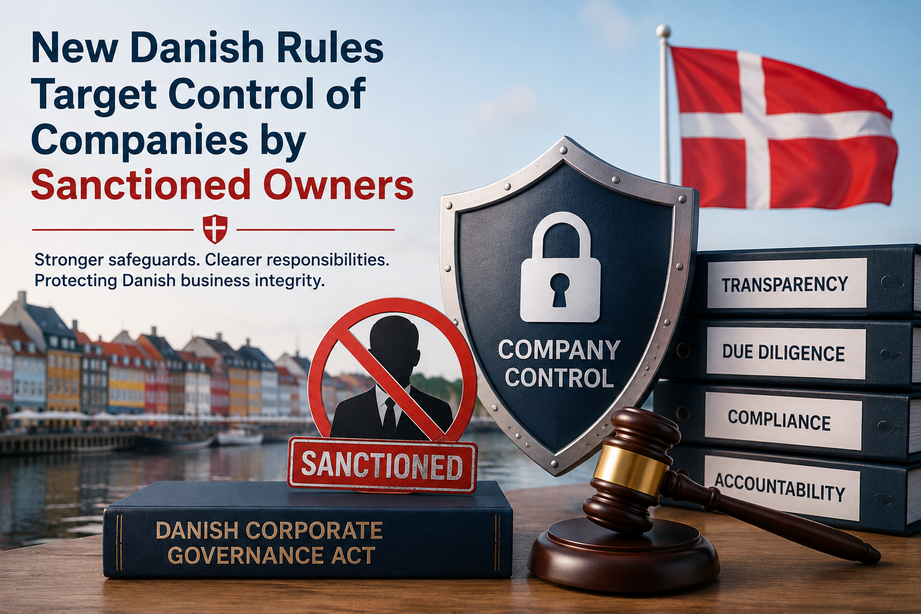
Denmark has strengthened its approach to companies connected to individuals or entities subject to international sanctions.
New Danish legislation introduces specific rules aimed at preventing sanctioned persons from exercising control over certain Danish companies and from receiving financial benefits from them. The measures address a difficult corporate-law problem: what happens when a company itself is not necessarily subject to sanctions, but one of the people who owns or controls it is?
The rules are particularly relevant as European sanctions have expanded considerably in response to Russia’s war against Ukraine and other international developments. For Danish businesses, directors, investors and international corporate groups, sanctions compliance can therefore extend well beyond checking whether a customer appears on a sanctions list.
For businesses following Danish corporate developments through Lead Roedl, the new legislation highlights the growing connection between sanctions law, corporate governance, ownership and management responsibility.
Denmark Strengthens Its Sanctions Framework
The Danish Parliament adopted the new legislation in May 2026, introducing rules concerning companies where a sanctioned person exercises control.
The legislation entered into force on 1 July 2026.
The objective is to ensure that sanctions cannot effectively be circumvented through ownership or control of a Danish company.
A sanctioned individual may, for example, own shares through a corporate structure or exercise influence over management decisions. If that influence allows the person to continue benefiting economically from the company, simply freezing assets directly registered in that person’s name may not always achieve the intended effect of sanctions.
The new Danish framework addresses this issue by allowing authorities to intervene at company level.
The Rules Focus on Control, Not Simply Ownership
One of the most important aspects of the legislation is its focus on control.
Corporate ownership can be complicated.
A person does not necessarily need to own 100% of a company to exercise meaningful influence over it. Control may arise through voting rights, agreements, indirect ownership structures or other arrangements.
This makes sanctions compliance more complicated than simply checking the name listed as the company’s immediate shareholder.
Companies may need to understand who ultimately controls the business.
That can involve examining:
- Direct shareholders
- Indirect ownership
- Ultimate beneficial owners
- Voting rights
- Shareholder agreements
- Rights to appoint or remove management
- Other arrangements that provide decisive influence
For international corporate groups, this analysis can become particularly challenging when ownership passes through companies located in several jurisdictions.
Authorities Can Restrict a Sanctioned Person’s Influence
Under the new Danish rules, the Danish Business Authority can intervene where a person subject to relevant EU sanctions controls a Danish company.
The authority can require the company to ensure that the sanctioned person does not exercise control.
This is a significant corporate governance measure.
In practical terms, a company may need to prevent the sanctioned person from using rights that would otherwise allow that person to influence corporate decisions.
The legislation is designed to stop sanctioned owners from continuing to direct business activities despite the restrictions imposed upon them.
For management teams, this can create difficult questions.
Directors normally have responsibilities toward the company and must operate within corporate documents, shareholder rights and Danish company law. Sanctions can change the practical situation by restricting how particular ownership or control rights may be exercised.
Financial Benefits Can Also Be Restricted
Control is only one side of the issue.
The legislation also addresses the economic benefits that a sanctioned person might receive from a company.
A company may generate profits, declare dividends or otherwise provide financial value to its owners.
If a sanctioned person can continue receiving those benefits, the effectiveness of the sanctions regime may be undermined.
The new framework therefore provides mechanisms intended to prevent sanctioned persons from receiving certain funds or economic resources from affected companies.
This can have consequences for payments such as dividends and other distributions.
Companies connected to sanctioned owners should therefore examine both decision-making rights and financial flows.
Preventing someone from voting at a shareholder meeting may not be enough if the same person continues to receive economic benefits that sanctions prohibit.
A Temporary Administrator May Be Appointed
One of the strongest tools introduced by the legislation is the possibility of appointing a temporary administrator.
The Danish Business Authority may appoint an administrator to an affected company when necessary to prevent a sanctioned person from exercising control.
This is an unusual and significant intervention in corporate affairs.
The administrator can be given authority to take steps needed to ensure compliance with sanctions requirements.
The precise consequences will depend on the circumstances of the company and the authority granted to the administrator.
For businesses, however, the message is clear: sanctions involving controlling owners are no longer simply a matter for the shareholder concerned. They can potentially affect how the entire company is governed.
The Company Itself May Continue Operating
An important purpose of the framework is to distinguish between a sanctioned owner and an operating company.
Where possible, the rules can allow the company to continue legitimate business activities while preventing the sanctioned person from exercising prohibited control or obtaining prohibited financial benefits.
This distinction matters for employees, customers, suppliers and other shareholders.
Immediately shutting down an otherwise lawful operating company could harm many people who have no connection to the conduct that resulted in sanctions.
The Danish approach instead provides tools intended to isolate the sanctioned person’s influence while allowing legitimate activities to continue where legally possible.
For businesses caught in this situation, however, continuing operations can require careful compliance management.
Management Has a Critical Role
Boards and executive management should pay particular attention to the new rules.
Sanctions compliance is no longer something that can safely be treated only as a banking or payments issue.
Management may need to understand who controls the company, whether any ownership changes have occurred and whether individuals connected with the ownership structure have become subject to sanctions.
Questions worth considering include:
- Who are the company’s ultimate beneficial owners?
- Does any sanctioned person hold direct or indirect ownership?
- Who controls voting rights?
- Are there shareholder agreements granting special influence?
- Who has the power to appoint board members?
- Are dividends or other payments being made to sanctioned persons?
- Have ownership structures changed recently?
- Are sanctions screening procedures regularly updated?
The answers can help management identify situations requiring closer legal review.
International Groups Face Additional Complexity
The new legislation is especially relevant to companies with international ownership.
A Danish subsidiary might be owned by another European company, which is itself owned through several holding companies before reaching an ultimate beneficial owner.
Sanctions compliance cannot always stop at the Danish company’s direct shareholder.
Businesses may need to look further up the ownership chain to determine who ultimately owns or controls the organisation.
This can be challenging where companies operate across multiple countries or where ownership arrangements involve trusts, investment vehicles, nominees or other complex structures.
Changes can also happen quickly.
A shareholder that presented no sanctions concern when an investment was made could later become designated under an EU sanctions regime.
Regular screening can therefore be more useful than treating sanctions checks as a one-time exercise performed when a business relationship begins.
Payments Deserve Careful Attention
Financial transactions remain another major area of risk.
Businesses dealing with sanctioned individuals or entities must consider whether making funds or economic resources available would breach applicable EU sanctions.
That question can extend beyond direct payments.
Companies may need to examine dividends, loans, distributions, asset transfers and other transactions that could provide an economic benefit.
Banks and financial institutions also carry out their own sanctions controls, which can result in payments being stopped or accounts being restricted while a transaction is reviewed.
For companies, identifying a sanctions issue internally before attempting a transaction can help avoid operational disruption.
Sanctions Due Diligence Is Becoming Part of Corporate Risk Management
The Danish changes illustrate a broader development in European business regulation.
Sanctions are increasingly relevant to ordinary corporate transactions.
A company considering an acquisition, investment or joint venture may need to investigate not only financial performance and legal liabilities but also the ownership and sanctions exposure of the parties involved.
This makes sanctions screening relevant to:
- Mergers and acquisitions
- Share purchases
- New investors
- Joint ventures
- Corporate restructuring
- Financing arrangements
- Dividend payments
- International trade
- Supplier and customer relationships
For M&A transactions in particular, identifying the ultimate owners behind a target or investor can be an important part of due diligence.
What Should Danish Companies Do Now?
Businesses do not need to wait until they discover a sanctioned shareholder before reviewing their procedures.
A sensible starting point is understanding the company’s ownership and control structure.
Companies can then consider whether existing compliance systems are capable of identifying sanctions-related changes.
Practical steps may include:
- Keeping beneficial ownership information current
- Screening relevant owners and controlling persons against applicable sanctions lists
- Reviewing shareholder agreements and voting arrangements
- Monitoring changes in ownership and control
- Checking significant payments before they are made
- Including sanctions checks in M&A due diligence
- Establishing procedures for escalating potential sanctions matches
- Documenting sanctions-related compliance decisions
International businesses should also remember that sanctions regimes can differ between jurisdictions.
An international group may therefore need to consider EU rules alongside requirements applicable in other countries where it operates.
Corporate Governance and Sanctions Are Becoming Closely Connected
Denmark’s new legislation demonstrates how sanctions law has moved into the heart of corporate governance.
The central question is no longer simply whether a company itself appears on a sanctions list.
Businesses may also need to understand who ultimately controls the company, whether that person is subject to sanctions and whether the person can continue influencing decisions or receiving economic benefits.
For companies following Danish corporate and international legal developments through Lead Roedl, this creates an important compliance lesson.
Ownership transparency, sanctions screening and corporate governance can no longer always be treated as separate issues.
A Danish company may continue to operate even when a controlling person becomes sanctioned, but management may need to take significant steps to prevent that person from exercising prohibited control or receiving restricted economic benefits.
As international sanctions continue to evolve, companies with cross-border ownership structures have a strong reason to know exactly who controls the business, how that control is exercised and where the financial benefits ultimately go.