



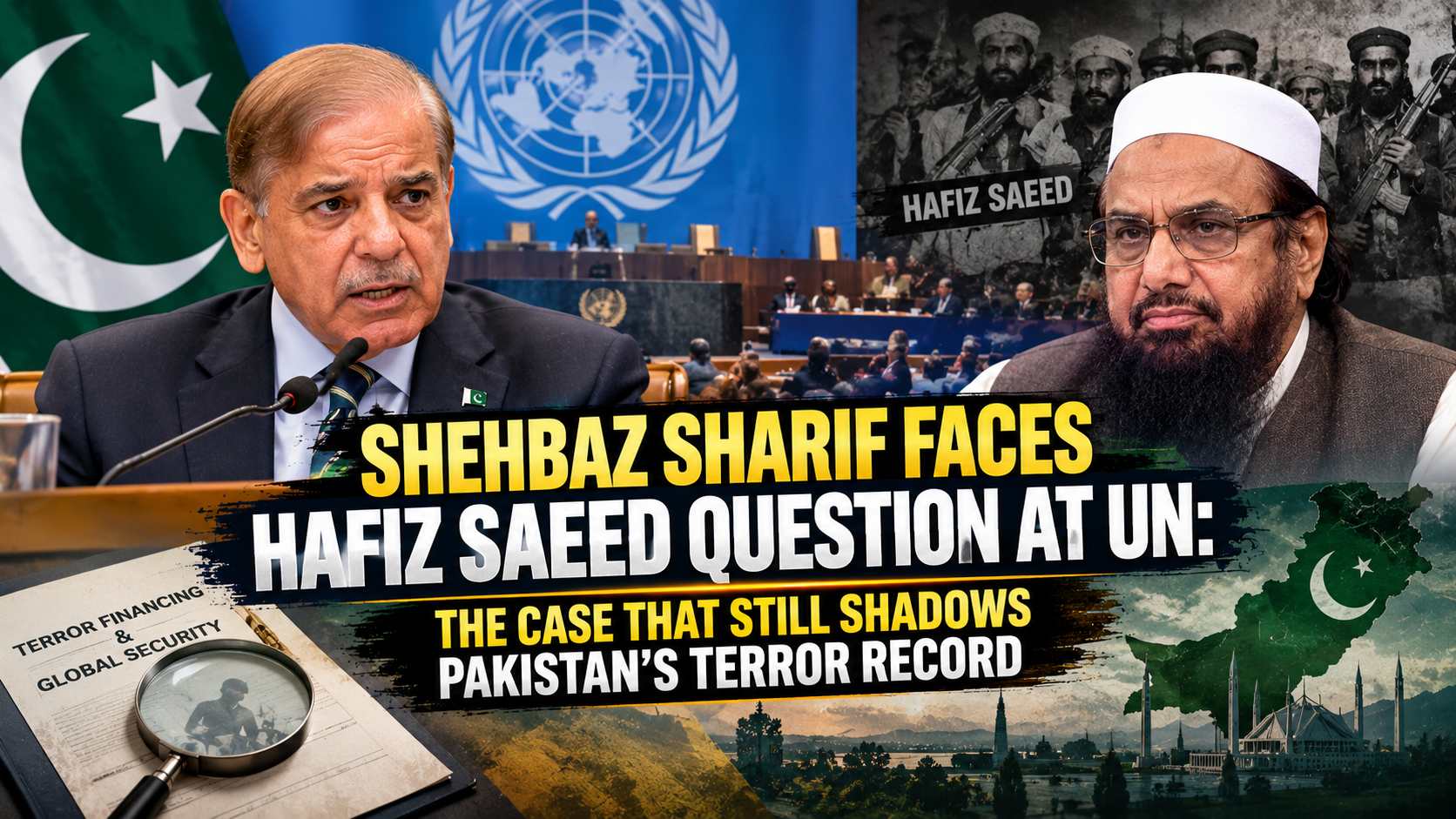
A short question outside the United Nations headquarters in New York put Pakistan’s Prime Minister Shehbaz Sharif in the middle of one of the longest-running disputes between India and Pakistan.
As Sharif arrived at the UN on September 24, a reporter asked him, “Prime Minister, when will you stop harbouring terrorists?”
Sharif did not respond.
Later, as he left the UN headquarters, another question followed: “When will you prosecute Lashkar-e-Taiba chief Hafiz Saeed?”
Again, Sharif did not answer and continued toward his vehicle. The exchange was captured on video and quickly became a focus of attention during Pakistan’s participation in the 81st United Nations General Assembly.
But the incident needs more context than the few seconds shown in the video.
Saeed is already serving a lengthy prison sentence in Pakistan. The unresolved issue is what exactly he has been convicted of, and what remains unprosecuted.
That distinction changes the story.
The Question Behind the Question
Hafiz Muhammad Saeed is the founder and leader of Lashkar-e-Taiba, an organization designated by the United Nations as a terrorist entity.
The UN Security Council’s sanctions record says Saeed was listed in December 2008 for his association with Lashkar-e-Taiba and Al-Qaeda and for involvement in financing, planning, facilitating and supporting their activities. The UN record also identifies him as a key leader of Lashkar-e-Taiba and Jamaat-ud-Dawa.
Lashkar-e-Taiba itself has been under UN sanctions since 2005.
The UN says the organization has carried out numerous terrorist operations and identifies the November 2008 Mumbai attacks among its major operations.
That history explains why questions about Saeed continue to follow Pakistani leaders at international forums.
But there is an important legal detail that is often lost in the political argument.
Saeed Is Already in Prison
Contrary to some descriptions circulating online, Saeed is not currently a free man.
According to the United Nations, the Pakistani government has held him in custody since February 2020. He is serving a 78-year imprisonment sentence resulting from convictions in seven terror-financing cases.
Those convictions followed Pakistan’s prosecution of Saeed under its domestic counterterrorism and terror-financing laws.
So the question asked to Sharif was not literally about whether Saeed has ever been prosecuted.
It was about prosecution for the major terrorist attacks with which India and international authorities have associated him, particularly the 2008 Mumbai attacks.
That is a much narrower and more complicated question.
Why Mumbai Still Matters
The November 2008 Mumbai attacks remain one of the central sources of tension between India and Pakistan.
Ten gunmen carried out coordinated attacks across Mumbai, targeting locations including hotels, a railway station and a Jewish community center.
The UN’s sanctions record states that Lashkar-e-Taiba conducted the attacks, which killed approximately 164 people and injured hundreds.
India has long accused Saeed of being among the key figures behind the organization responsible for the attacks.
The question of accountability has therefore remained part of India’s diplomatic pressure on Pakistan for years.
The fact that Saeed is serving a sentence for terror financing does not automatically resolve that separate issue.
A Terror-Financing Conviction Is Not the Same as a Mumbai Prosecution
This is perhaps the most important distinction in the story.
A person can be convicted of financing terrorism without being convicted of a specific terrorist attack.
Saeed’s current 78-year sentence stems from seven terror-financing cases, according to the UN. It is not described by the UN as a conviction for the Mumbai attacks.
That explains why the question continues to arise.
From India’s perspective, the existence of a terror-financing conviction does not settle the issue of responsibility for the 2008 attacks.
From Pakistan’s legal perspective, however, any additional prosecution would require evidence that meets the country’s judicial standards.
Those are two different questions, and neither should be collapsed into the other.
The UN Status Makes the Issue Even More Sensitive
Saeed’s status is not based solely on India’s accusations.
The United Nations formally listed him in December 2008.
The current UN sanctions record says he was listed for his association with Lashkar-e-Taiba and Al-Qaeda and for participating in or supporting activities including financing and planning.
UN sanctions currently impose measures including an asset freeze, travel ban and arms embargo on designated individuals and entities on the relevant sanctions list.
That gives the Saeed issue an international dimension.
It is no longer simply a bilateral argument between New Delhi and Islamabad.
His name appears in an international sanctions framework maintained by the UN Security Council.
India Has Also Linked Saeed to the Pahalgam Case
The controversy has gained another layer because India’s National Investigation Agency has named Saeed as an accused in a supplementary chargesheet connected to the April 2025 Pahalgam terror attack.
India alleges that Pakistan-based Lashkar-e-Taiba operatives were involved in the attack and has identified Saeed as Accused No. 8 in the broader conspiracy.
These are Indian investigative allegations, not a judicial finding against Saeed in a completed trial.
That distinction is important when reporting the case.
The allegations have nevertheless kept his name at the center of India’s wider argument that Pakistan needs to take stronger action against individuals and organizations linked to cross-border terrorism.
Why the Question Came at the UN
The timing was significant.
Sharif was in New York for the UN General Assembly, an international stage where Pakistan seeks to present its position on security, regional conflicts and terrorism.
Pakistan has also repeatedly portrayed itself as a country that has suffered heavily from terrorism.
That makes questions about individuals associated with internationally sanctioned militant organizations particularly sensitive.
The reporter’s question effectively brought a long-running India-Pakistan dispute directly into the UN setting.
Sharif’s decision not to respond did not establish a new Pakistani policy.
It did, however, ensure that the question itself became part of the day’s political conversation.
Pakistan’s Counterterrorism Record Remains Under Scrutiny
The Saeed controversy also sits within a broader international discussion about Pakistan’s efforts against terrorist financing.
Pakistan was removed from the Financial Action Task Force’s increased-monitoring list in 2022 after completing an agreed action plan, although the FATF and its regional partners continue to assess countries’ anti-money-laundering and counterterrorist-financing systems.
It would therefore be inaccurate to suggest that Pakistan currently faces the same FATF monitoring status it once did.
At the same time, questions about the effectiveness of prosecutions, asset freezes and enforcement against designated individuals have not disappeared.
The Saeed case illustrates why.
The Bigger Issue Is Accountability
The argument surrounding Saeed often gets reduced to a simple question: Is Pakistan prosecuting him or not?
The reality is more complicated.
Pakistan has prosecuted and convicted him on terror-financing charges.
The United Nations recognizes those convictions and records that he remains in Pakistani custody.
But India continues to seek accountability for his alleged role in the Mumbai attacks, and Indian authorities have also linked him to the Pahalgam case.
Those different legal tracks explain why his name remains politically significant more than a decade after Mumbai.
Sharif’s Silence Became the Story
There was no extended confrontation.
There was no heated exchange.
There was simply a question, followed by silence.
Yet that brief moment carried considerable weight because it touched on an issue that has repeatedly strained India-Pakistan relations.
Sharif could have responded by pointing to Saeed’s existing terror-financing convictions.
He could have emphasized Pakistan’s legal position.
He could have addressed India’s allegations directly.
Instead, he did not answer.
That silence should not itself be treated as proof of any particular Pakistani policy or legal position.
But it did leave the central question hanging.
What Would Actually Resolve the Dispute?
Ultimately, another political exchange outside the UN building will not settle the Saeed controversy.
What matters is evidence, judicial proceedings and cooperation between the countries involved.
India has repeatedly sought accountability for the Mumbai attacks.
Pakistan has conducted prosecutions related to Saeed’s financing activities.
International sanctions remain in place.
The unresolved question is whether the evidence available to Pakistani authorities can support additional proceedings relating to specific attacks and alleged conspiracies.
That is ultimately a legal question rather than something that can be settled by a microphone outside the UN.
A Question That Has Outlived the Headlines
The scene outside the United Nations lasted only seconds.
But the issue behind it has lasted nearly two decades.
Hafiz Saeed remains internationally sanctioned, remains in Pakistani custody and remains convicted of multiple terror-financing offenses.
At the same time, India continues to demand accountability for his alleged role in major attacks, including the 2008 Mumbai attacks.
That is why the question asked to Shehbaz Sharif resonated beyond the video itself.
It was not simply, “Where is Hafiz Saeed?”
The more consequential question was:
What does accountability look like when a person is already imprisoned for one set of terrorism-related offenses but remains at the center of allegations concerning some of the region’s most consequential attacks?
Sharif did not answer that question at the UN.
And for now, the wider dispute between India and Pakistan over terrorism, evidence and accountability remains unresolved.